% in Europe Willingto Accept Muslim Into Their Family
Some 25 million Muslims alive in the 28 Member States of the European Union. The vast majority of these Muslims came seeking work and they were needed equally they worked in sectors usually referred to as "difficult, dingy and unsafe". In the lxxx's, they started to exist perceived not every bit Immigrants from Morocco, Islamic republic of pakistan or Turkey but as "Muslims", eventually threatening the social fabric of European societies. The terrorist attacks by tiny groups of Islamist fanatics and the radicalisation of "thousands" of native Muslim Europeans added fuel to the surging anti-Muslim sentiment in Europe. Unless there is a simultaneous try by immigrants to improve integrate in European societies and by European Societies to bear witness openness, tensions may become worrisome.
The presence of some 25 million Muslims in the 28 countries of the European Union is currently sparking debate, controversy, fear and even hatred. Never before accept nosotros witnessed such a climate of common suspicion between Muslims and mainstream European societies. Public opinion surveys in Europe bear witness increasing fearfulness and opposition to European Muslims, who are perceived as a threat to national identity, domestic security and the social cloth. Muslims, on the other hand, are convinced that the majority of Europeans refuse their presence and vilify and caricaturise their religion.
Surveys bear witness increasing fear towards European Muslims, who believe that Europeans caricaturise their religion
Such a misunderstanding is worrisome as it fuels dangerous Islamophobia, on the one hand, and radicalisation, on the other. European states are alarmed by these developments since they place harmonious cohabitation in jeopardy. Consequently, they have taken measures and enacted laws to gainsay extremist forces, curb radicalisation and improve Muslims' integration into the receiving countries.
However the situation is non unproblematic. How could Europe encourage Muslim integration into secular states? Are radicalisation and extremism linked to economic marginalisation? Are they a product of a narrative that divides the earth into ii camps: the states and them? Is extremism is only organized religion-based? If so, why did an extremist Norwegian kill, in 2011, dozens of his compatriots who were not Muslims? European states continue to grapple with these thorny questions without being able to devise a coherent response.
My arguments are that Muslims are settling permanently in Europe, that the vast majority want to live in peace, that European integration policies have been erratic and inconsistent and that just a tiny minority of Muslims are engaged in radical activities. I also fence that in addition to faith-based radicalisation (religiously-motivated groups or individuals), there is an identity-based extremism (far-right parties), which is no less unsafe, and Europe should face up both problems by drying upwardly the ideological sources of extremism. Finally, I make the point that Islamist radicalism in Europe remains marginal. This radicalism is non the result of failed integration, merely rather local-global connections, which are linked to identity rupture and the exposure of young European Muslims to the unbearable images of destruction and violence in many Muslim countries, mainly those in the Middle Due east. Whether this violence is the event of Western intervention, such as the invasion of Iraq and the Israeli offensives in Gaza, or the result of the assault of Muslim regimes on their own populations, such as in Iraq or Syria, is irrelevant.
The Muslim population in the EU is mainly linked to migration dynamics
The presence of Muslims in Europe is not a new phenomenon. Starting in 711, Muslims conquered large swathes of Northern Mediterranean shores and set Caliphates and Emirates mainly in the Iberian Peninsula for more than seven centuries. The fall of the concluding Emirate of Granada, in 1492, marked the end of Muslim political rule in Espana. Later on, the Inquisition led to the very expulsion of Muslims, Sefardi Jews and converted Spaniards.
About concomitantly, in the Eastern Mediterranean, Islamised Ottomans defeated the Greeks, ejected them from Anatolia, took Constantinople (1453), which later became Istanbul, and conquered the Balkan region. Balkan States accomplished their independence in the 19th century, before the dismantlement of the Ottoman Empire in the aftermath of the Kickoff World State of war. Muslim Bosnians, Albanians and Kosovars have not been expelled, and nowadays, they plant Europe'southward indigenous Muslim population.
This commodity specifically tackles the issue of Muslims who immigrated to Europe after the 2nd World War and who now represent the majority of the European Union'southward Muslims. Indeed, as European states started their reconstruction at the cease of the war, they resorted to their ex-colonies to offset labour shortages. Hundreds of thousands of North Africans, most of them Berbers from traditionally rural areas of the Rif Mountains, immigrated to France. Indonesians and Surinamese went to Holland, and Indians, Pakistanis and Bangladeshis entered the United Kingdom. The example of Germany is more specific since it has been the chief destination of Turkish and Kurdish labour immigrants, although Turkey was non a German colony, but simply an ally in the First World State of war.
Obviously, not all labour migrants in the 1950s were Muslims, merely given that the immediate chugalug surrounding Europe consists of Northern African and Middle Eastern Muslim countries, most of which take been colonised by European countries, information technology is no wonder that the majority of strange labour migrants in Europe are Muslims. Those migrants left their countries in the 1950s and 1960s in search of piece of work, social advantages and higher wages. The vast bulk of these showtime generation migrants were young. They did not intend to settle permanently but hoped to accumulate sufficient savings, which would allow them to build a house, open a shop, buy a taxi, etc. and prepare a winning return to their home country. Since their stay was seen as temporary, these migrants, whether single or married, sent home nearly eighty% of their salaries to their families equally remittances.
On the whole, these migrants contributed to the economic boom of many European states as they built roads and railroads, worked in the coal mines, cleaned streets and offices and, on the whole, did the jobs that Europeans were reluctant to practice. Until 1970, in that location was neither a migration "problem" nor, a fortiori, a Muslim "problem" in Western Europe. Migrants were largely invisible in public places. They had no specific demands related to their faith as they did not intend to settle permanently, and they did not suffer from bigotry or prejudice every bit they were contributing to the well-being of European societies. In that location was no Islamophobia, although grade racism did be. In summary, migration was seen as a gift, not every bit a burden and even less every bit a threat.
In the early on 1970s, the European economical boom came to a halt. The oil crisis of 1973 was the "straw that broke the camel'south back", as the Arabs say. From that yr on, European states enacted laws restricting regular migration but, at the same time, relaxing restrictions of family reunification. Immigrants hurried to bring over their families. These measures produced significant quantitative and qualitative furnishings. Statistically, the sheer size of the migrant population increased considerably in the 1970s and the 1980s. Economically, the number of workers among migrants dwindled drastically. Sociologically, there has been a process of feminisation of the migration stocks while the presence of children inaugurated the 2d-generation phase.
All of these transformations produced unforeseen effects. First, the arrival of families from rural areas changed the immigrants' attitudes towards religious and cultural values. While temporary workers accepted "basement mosques" (les mosquées des caves) as a temporary solution to their prayer needs, the sedentarised immigrants asked for mosques and minarets. Secondly, the visibility of migrants in public space increased (veiled women, children going to school, etc.) Thirdly, immigrant families congregated in certain areas where they could find informal support structures and social networks. Families could thus keep in abiding contact with their home countries past phone, internet or travel.
The EU faces a daunting challenge, since defensive and protective policies in the Mediterranean did not succeed in deterring aviary seekers, refugees and migrants
Finally, in the last three decades, marriage clearing peaked every bit the first and 2d-generation youth entered the marriage market. To have but two examples from Holland, betwixt 1995 and 2003, Turkish marriage immigration peaked at 4.000 per year while Moroccan marriage clearing hit a record of 3.000 per year. Wedlock immigration ensured continued, high fertility amongst the immigrant population as many 2d-generation immigrants prefer to marry spouses from their parents' dwelling countries, who are immature, traditional and virgin, rather than marrying a fellow 2d-generation immigrant like themselves. Obviously, spousal relationship immigration has maintained the migration dynamic intact.
This significantly differentiates Muslim immigration to Europe with the Muslim expatriation in the U.s.a. on 2 grounds. First, Muslim migrants in Europe are, at about, a two to iv hour flight from their home countries, while the altitude betwixt the USA and their dwelling house countries gives little choice just to integrate into the American "melting pot". Secondly, every bit Robert Leiken argues, "unlike the American Muslims who are geographically lengthened, ethnically fragmented and mostly well-off, Europe'south Muslims get together in dour enclaves with their compatriots". Finally, the rate of mixed marriages in the USA is higher than in Europe.
This differentiation explains, to a certain extent, why Islam and Muslims in the Us are not a major concern while in Europe, at least since the 1980s, migration has become an effect, mainly considering two-thirds of the migrants are Muslims. Indeed, everything related to Islam in Europe became a cause of feet: the mushrooming of mosques, women's veils and new religious fervour. It is in this context that far-right parties emerged and started to garner support in presenting migration equally a threat. In reaction, Western European states began erecting new defences against the much mediatised threat of mass immigration by strengthening directly immigration control through severe visa regimes, internal surveillance and outsourcing border command on the external borders of the Eu.
But all cordons sanitaires put in place could non end or even slow the flow of irregular migration from southern countries. The long state border and coastlines of many European states hindered the effective policing of frontiers. In many cases, land and maritime controls but served to readapt the routes of migration, making the travel longer and riskier and making traffickers richer as they showed their ability to adapt to the new regulations. Southern European countries were particularly exposed to irregular migration. At the beginning, Spain, Italy, Greece and Republic of malta were transit countries and "stepping stones" for other destinations. But afterwards, in the 1990s, they became countries of final destination for waves of irregular migrants.
Thousands of these irregular migrants lost their lives in an effort to reach the perceived "European Eldorado". Only hundred of thousands made it. They lived in precarious situations, as illegals, irregulars or indocumentados, merely over the years, they have been legalised, in what Spain has called regularizacion, and Italia, sanatoria. In this respect, the case of Spain is emblematic every bit the number of asentados Moroccans, to take just 1 example, jumped from fifty.000 in 1992 to 750.000 in 2015, which is a multiplication past 15. The aforementioned happened in Italy. The so-called "fortress of Europe" proved to be an practice in fantasy. Undoubtedly, restrictive visa regimes affected legal migration but triggered irregular migration. Externalised control of migration and detention camps take not discouraged migrants. It is, therefore, not surprising that today, there are more than than one million Muslims in Spain and a similar figure in Italy.
The problem has get more astute recently with the substantial increase of asylum seekers from impoverished or devastated countries in the S, like Syrian arab republic, Iraq, Afghanistan, Eritrea and even the Gaza Strip. While the Mediterranean is being transformed into a cemetery of drowned dreams, European countries are bickering about the cost-sharing of country borders and coastline policing and near distributing asylum seekers amongst European states.
Let us recognise that the challenge is daunting since defensive and protective policies in the Mediterranean did not succeed in deterring asylum seekers, refugees and migrants. European leaders establish themselves defenseless between alarmed rejectionists, who invoke financial costs, security risks and social challenges and who inquire for more muscular policies to stem the menses of mass immigration, and vocal refugee advocates, who posit the trouble in terms of human dignity and the necessity to protect, recalling the instance of Jordan and Lebanon, which are hosts to more than a million Syrian refugees each.
There is no incertitude that the state of affairs is difficult to manage. On the one hand, in confront of the magnitude of the human tragedy, Europe cannot remain blind, deafened and with its arms crossed. On the other, it cannot leave its doors wide open to the misery of the world. This historical review conspicuously shows that through natural increase and new migration flows, in all their forms, the Muslim population is increasing rapidly in the European Union to the cliffhanger of European states, caught off baby-sit by the sheer numbers of refugees and asylum seekers. Ane can easily bet that the anxieties which environs the migration upshot will not vanish as long as neighbouring Muslim countries remain feverish and destabilised and as long as European Islam is constructed every bit a problem.
Who are the Muslims in Europe?
Muslims in Europe fall into six categories:
one) Ethnic Muslims who accept lived in Europe for many centuries, mainly in Bosnia, Albania and Kosovo, where Islam is a foundational element of their history, but also in Romania and Bulgaria, where they are a native minority, and Poland and Crimea, which is abode to an former Tatar Muslim population.
2) Students and businessmen who come from Muslim countries. In France alone, there are some 70.000 North African students, and London is the upper-case letter of Arab and Muslim businessmen.
3) Muslims who entered initially without restriction, such every bit the Commonwealth citizens in Keen Britain, Algerians in France or Surinamese and Indonesians in The netherlands.
four) Muslims who came to Western Europe, in the 1950s and the 1960s, equally labour migrants.
5) European Muslims who are built-in in Europe to migrant parents.
6) And, finally, asylum seekers and refugees, whose numbers accept substantially increased in the last iii years. From January to August 2015, 235.000 refugees poured into Europe, the majority of them from neighbouring Muslim countries.
Europeans greatly overestimate the share of Muslims in the full population: The French estimated it at 31% in French republic, while information technology does not exceed half-dozen%
We don't include in these categories the 30 million Muslims of the Russian Federation, which includes many Muslim countries. In this article, nosotros shall deal only with Muslims of migrant origin in the Eu. They autumn into three categories: a) those who are registered equally foreigners; (b) those who acquired the nationality of the country where they alive and piece of work; and, finally, (c) those who are native European.
On the whole, I guess that in that location are some 23 meg Muslims living in the 28 European states, three-quarters of whom are already European citizens past naturalisation or birth. To these numbers, we may add some two million Muslims who migrated illegally and have non yet been officially legalised. This makes a total of 25 million Muslims, some 5% of the total European population.
These numbers are not threatening. And yet there is a widespread sentiment that Europe is beingness invaded by a growing Muslim population that cannot or will not exist assimilated and that dreams, as blogger Agnon de Albatros argues, of "implementing Shari'a police force in Europe and making this infidel continent office of the domain of Islam" (world wide web.albatros.org). Thus, the Muslim demographic is becoming a central theme of many books, in which Muslims are perceived every bit posing "the most acute problems on account of their religion and their numbers" (Christopher Galdwell). Right fly parties are non proverb anything else. "Against the Islamisation of Europe" was the slogan chanted by the Pegida German protesters in Dresden, in 2015.
Is there a reason for concern? For many Europeans, the answer is yeah, not just because of the increasing number of Muslims in Europe, but also because Europeans greatly overestimate the share of Muslims in the total population. A 2014 poll from the Social Research Institute found that French respondents estimated the percentage of Muslims in France at 31%, while the existent percentage does not exceed half dozen%. Germans gave the percent at 19% in spite of the actual four%.
Some demographers are not less anxious. They recognise that the total Muslim population is projected to jump from 25 to 35 1000000 between 2015 and 2035. They invoke both internal and external factors. Among the internal factors, they pinpoint the college fertility rates amongst Muslim Women and the fact that Muslim population is younger: people nether the age of xxx correspond l% of the Muslim population in 2015, compared with about 33% in the non-Muslim European population. They also argue that Muslim women marry in larger numbers and at younger historic period and divorce less than their non-Muslim counterparts.
To these internal factors, one must add net migration influx. In spite of its economical crisis, the European union remains a migration magnet for Arabs, Sub-Saharan Africans, Asians, etc. Recent events in the Mediterranean, in 2015, conspicuously indicate that both "push" and "pull" factors are still at play. As a matter of fact, current migration pressures are non caused exclusively by external push button factors, such every bit poverty, conflict and repression. The electric current focus on push factors diverts attention away from significant pull factors, such as the very fact that the European countries are already hosts to pregnant immigrant or immigrant-origin populations, opening new channels for migration. As Esther Ben David puts it, "the more people immigrate from a certain boondocks or hamlet, the more probable it becomes that their neighbours […] will follow in their path".
To this reality, 1 has to add together travel accessibility, expanding international networks and the fact that there is even so demand at the upper end of the labour market for highly qualified professionals, and at the lower end, in that location is demand for workers in unregulated sectors of the economy, which depend on a cheap and exploitable workforce to remain competitive. Conspicuously, migration pressures from Muslim and not Muslim countries will not diminish any time soon. Yet, in spite of the projected increase in Muslim demographics in the European union, in no European state volition the Muslim population exceed ten% of the total population by 2035, with the exception of France and Belgium.
European integration policies and the segregation realities
From the very starting time of labour migration, in the 1950s and 1960s, European states have adopted unlike policies with respect to managing their immigrants and integrating them. Some countries, similar Germany, did petty in the outset decade to facilitate the integration of its migrants. It viewed them every bit temporary "guest workers" (geist arbeiter). The United Kingdom and the netherlands embraced the notion of multiculturalism, by which the governments sought to maintain distinct cultural identities and customs. French republic, by dissimilarity, professed a policy of assimilation by imposing its model of secularism.
The social unrest was almost concomitant with the terrorist attacks in Madrid and in London, serving as center-openers and questioning old integration models
Whatever the model, the immigrants, as I said earlier, gathered in ethnic neighbourhoods, chosen banlieues, in French republic, and suburbs, in England. After the economic downturn of the 1970s, and the closure of mines and factories, immigrants became the first to bear the brunt of the crunch. Unemployment skyrocketed, leading to widespread riots in the United Kingdom and in French republic (la révolte des banlieues, in 2005 and 2007). Although a large number of the rioters appeared to exist Muslims, most observers agree that urban segregation and the lack of opportunity and upward social mobility were primal factors behind the unrest. The social unrest was almost concomitant with the mortiferous terrorist attacks in Madrid, in 2004, and in London, in 2005. French republic had already suffered similar terrorist attacks in 1997. The netherlands and Kingdom of denmark were not spared, with the assassination of filmmakers and cartoonists.
These tragic events served as eye-openers. Former integration models came under attack. Multiculturalism in the Great britain and in The netherlands has been questioned, and gradually, the policy has been abandoned, and governments accept stepped up their efforts to amend integrate their Muslim communities. Deutschland relaxed its naturalisation policy and allowed Turks and Kurds to larn German nationality. Only France stuck to its secular model.
Undoubtedly, in the last xv years, the issue of migration and integration policies has dominated the political and intellectual debate, with ii questions gaining particular momentum: Are European Muslims discriminated and segregated? And, if so, should the European states exist held responsible? The respond patently varies according to ideological affiliations and political stands, merely let's stick to the facts. As the bulk of Muslims are labour immigrants or native-born of immigrant origin, they are poorer than the national average, and they oftentimes live in segregated neighbourhoods. However, it is besides truthful that poverty is oftentimes linked to poor parental control, dropping out of school and the lack of opportunities. In addition, there was an alarming development in the 1980s. The migrants, whose problems were seen as a effect of their socio-economical status during the preceding decades, started to exist perceived as culturally unlike.
The apparent failure to integrate has been viewed in cultural terms, that is, equally failure to adapt to European culture and to adopt European norms, values and styles. In other words, Muslims do not integrate considering they are Muslims, and Islam is perceived every bit incompatible with Western civilization and values. Thus, information technology is no surprise that Islam has been constructed as a problem.This shift in perception is synchronic with the advent, since 1979, of the then-chosen Islamic revival. Indeed, in the 1960s and 1970s, the "other" was a labour migrant from Turkey, Morocco, Algeria or Islamic republic of pakistan, etc.; however, in the 1980s, these migrants became trapped in i communitarian cage: Islam.
However, in that location is no one Muslim community in Europe; this is a fantasy. Muslims come from unlike countries, alive in different countries and speak different languages. They are immensely divided in their faith, in their ethnicity and besides in their relation to religious practice and to the role faith plays in their lives. It is therefore erroneous to remove the migrant from his own condition. A migrant built-in to Algerian migrant parents with French nationality is get-go of all French. So why should nosotros encage him in a Muslim community supposedly airtight and fixed forever? Speaking constantly of Muslim community ways that Islam eclipses the private Muslim as the presumed actor of social and political change. In other words, as Sami Zemni, from the University of Gent, argues very aptly, "It is non Muslims who produce history, merely Islam that conditions the behaviour and identity of Muslims. […] In the end a Muslim is an automatom, endlessly perpetuating the religious prescriptions of Islam". Such a postulate is both erroneous and dangerous, not only considering Islam assumes the office of an internal enemy in a societal cold state of war betwixt European societies and their Muslims, merely also considering the integration issue is asunder from the socio-economic context and becomes the sole responsibility of Muslims.
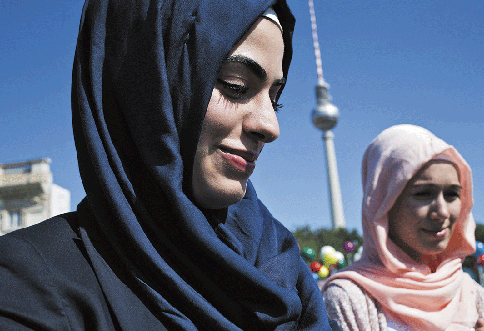
Happily enough, many Muslims are fighting their way into European societies and gradually integrating their norms. Many success stories of Muslims in all sectors, from economy to civilisation, provide aplenty proof that there is no Muslim fatality. Muslims with higher teaching and higher wages—like the 300.000 Arabs of the Centre E residing in London or the Lebanese expatriates in Paris—practice non live in segregated communities and are well integrated in society. Unfortunately, the bulk of Muslims in Europe are labour migrants or sons of labour migrants who are badly equipped to better integrate into European societies, non because of Islam, but because of their socio-economic condition.
Should we, therefore, incriminate official policies for the lack of integration? I believe so, to a certain extent. In that location have been shortcomings and even failures in French republic and elsewhere. Urban policies have been inadequate. Employment incentives have been limited and task discrimination comparatively addressed. All of these shortcomings are now nether review, and measures are existence taken, unfortunately, upwards until now, with scarce results.
Muslim youth of Europe, radicalisation and violence
European states recognise that the vast bulk of Muslims in Europe practice not engage in violence or terrorist activities, but, at the same time, they admit the existence of pocket-size cells or "lone wolves", which are considered to exist radical Islamists, decumbent to violence and with links to Al-Qaeda or ISIS (the Islamic Country). Personally, I don't share the theory of the lone wolves because behind each terrorist, at that place are groups which provide logistics, armament and training. But thorny questions have to be raised: How does a native European Muslim become radicalised? Why?
The assertion that Islam is the religion of the sword, and that other religions, such as Christianity, Judaism or even Buddism, are religions of peace is grossly misleading
The radicalisation of some habitation-grown Muslim youth can take place in radical mosques, in prison, during long stays in Muslim countries or through the cyberspace. The 2004 Madrid bombing, which killed 192 people, was carried out by North Africans, more often than not Moroccans, who were residents in Espana, simply some, reportedly, had links with a Moroccan terrorist grouping affiliated with Al-Qaeda. Three of the 4 perpetrators of the 2005 London attacks were home-grown, second-generation British Muslims trained in Pakistan. Merah, the French terrorist who killed three soldiers and 3 Jewish youth in Toulouse, and those who assassinated Charlie Hebdo'southward cartoonists and Jewish shoppers were second-generation French Muslims of Algerian descent. Moreover, some young Muslim jihadists who join ISIS in Syria and Iraq are built-in and educated in European countries, and many of them are even European Muslim converts.
Why, then, does a tiny minority of Muslim European youth engage in violence? Answers tend to differ significantly. One school of thought adopts a culturalist view, which links terrorism, jihadism and extremism to the Islamic religion itself. For its proponents, violence is consubstantial to Islam since about of the modernistic conflicts are taking place in Muslim countries and since the bulk of terrorist groups are Muslims, such equally al-Qaeda, ISIS, Boko Haram, Somali Al-Shabab, etc.
A second school of idea, considered to be realist, asserts that the failure of European governments to fully integrate Muslim communities leaves some European Muslims more vulnerable to jihadist ideologies. Some young people feel so left behind and alienated that they plow to Islam as a badge of cultural identity. In a contempo interview, Salman Rushdie explained the post-obit: "Requite a Kalachnikov and a black compatible to an unemployed youth, who is vulnerable and disadvantaged, and you confer to him a power" (Le Vif Express, fourteen – 20, August 2015).
Clearly, these arguments are not convincing. The assertion that Islam is the religion of the sword (organized religion de l'épée), and, by dissimilarity, that other religions, such every bit Christianity, Judaism or even Buddism, are religions of peace (religions de la paix) is grossly misleading and historically erroneous. For centuries, religious wars split European countries apart. Nowadays, Buddhist monks organise mass killings and deportations of Muslims in Myanmar, and Jewish extremists colonise Palestine and abuse secular Jews in the name of God.
Only neither is the other argument totally apparent. First, there are millions of immigrants who suffer from segregation, bigotry and lack of opportunities but who do not engage in terrorist activities. Secondly, some terrorist attacks, like those carried out in the Us in 2001, were perpetrated by well-educated and economically comfortable individuals. And thirdly, among those who join ISIS in Syrian arab republic and Iraq, one tin can find entire families or even converts.
In my humble opinion, 4 factors might help fully grasp the gradual process of radicalisation. The first is identity-based radicalisation. For many young Muslims of migrant origin, whether left behind or fully integrated, there is a widespread feeling that they are not fully accepted as fellow citizens. After three generations, a French citizen of Algerian descent is still perceived as an Algerian and a Muslim. He may never take visited People's democratic republic of algeria, and he may be a non-believer, just he is still perceived as an conflicting. Clearly, some Muslim youth feel torn apart between a country of origin they don't know and their home countries (France, Belgium or Deutschland) that plow their back on them. It is no small wonder that some youth curse the country in which they are born and raised.
The second factor is socio-economic based radicalisation. This form of radicalisation is related to the socio-economic grievances harboured by 2d and third-generation Muslims. Undoubtedly, the lack of opportunities is linked to objective failures like poor instruction and preparation. Others are linked to job bigotry. For case, a friend of mine, a immature Algerian Muslim and an fantabulous engineer, sent an awarding for a task vacancy and signed the letter with his true name. He received an reply that the job was no longer vacant. He sent the same letter with some slight modifications, including his westernised name, and he was summoned for an interview. This happens frequently and feeds the sentiment that university studies are not necessarily a ladder of social mobility in the case of many Muslims. In the long run, this may sow the seeds of hatred.
The minority Muslim youth radicalisation in Europe has more to do with today'south global-local connections rather than with failed integration
The third factor is the search for a mission. In many cases, nosotros saw terrorists who became suddenly, fervently self-radicalised and fanatically religious, breaking off from their families and friends and embodying what Oliver Roy called a "generation rupture". These self-radicalised youth pursue a fantasy of heroism, which I called the passage from "zero to hero", or, the passage from anonymity to celebrity. "We have avenged the Prophet Muhammad", shouted the killers of the Charlie-Hebdo cartoonists, in January 2015.
This cocky-radicalisation is partly due to persistent, socio-economic challenges, but also to the exposure to social media and to satellite television set, some of which is generously financed. It is no secret that some petrodollar-financed satellite channels propagate a literalist reading of the Koranic texts, indirectly contributing to the forging of a radical mindset that is decumbent to see the world with binary logic: Islam versus the Other, Expert versus Evil. Such logic leads to fanaticism and the rejection of negotiation, dialogue or compromise. Here lies the difference between a religious radical terrorist who doesn't negotiate and a nationalist terrorist who does.
The fourth factor is geopolitical based radicalisation. This relates to the constant exposure that young European Muslims have of the sufferings inflicted by the West and its regional allies on fellow Muslims in many parts of the Arab and Muslim worlds. It is non fortuitous that Al-Qaeda and later ISIS increased their activities in Iraq after the American invasion in 2003. The three Israeli offensives in Gaza (2007, 2012 and 2014) produced dramatic resentment amongst Muslims against Israel and its western allies, mainly the Americans, who were accused of having double-standards for continuing by Israel, in spite of its continuous breaches of international law and violations of human rights. Only the belief that those terrorists who orchestrated the horrific attacks in Madrid, London and elsewhere were avenging the suffering of the Palestinians is wrong and misleading. Palestine has been more than of a justification than a source of radicalisation for some young European, radical Muslims.
All of these forms of radicalisation may converge or not. We have seen cases of native European converts engaging in terrorist activities. The September xithursday terrorists were highly skilled and affluent. Many terrorists are not religious but suddenly get fanatically religious in a sort of breezy religious radicalisation. We have also seen cases of radicalisation in countries, such as Holland, which have done much to accommodate Muslim immigrants (affirmative action hiring policy, free language courses, etc.) Equally a matter of fact, Mohamed Bouyeri, who murdered the filmmaker Theo Van Gogh, was built-in in The netherlands and was collecting unemployment benefits.
These facts do not totally invalidate the relationship between failed integration and radicalisation. But what seems unquestionable is that the minority Muslim youth radicalisation in Europe has more to do, every bit Anna Triandafyllidou argues, "with today's global-local connections rather than with failed integration or ethnic penalization".
The Islamophobic construction of the Muslim "problem"
Let us reiterate an undeniable fact: since 711, Islam and Muslims have obsessed and captured the European imagination, commencement as conquerors, so as a competing organized religion and finally as the internal "Other" with the new waves of migration. Thus, Islamophobia as a fear or a prejudiced stance of Islam and Muslims is not a new phenomenon; information technology would suffice to read the thousands of books on "Islam and Europe" since the Islamic conquest of the Iberian Peninsula until at present. During the last centuries, we take had polemists and historians who described Islam as the "mirror of Europe"—it is what Europe is not (or no longer): fanatic, violent, intolerant and misogynous. In such an essentialised image, Islam has been perceived as a homogeneous mass, static and unresponsive to modify. Edward Said, in his volume Covering Islam, has shown the intellectual fallacy of such a postulate, every bit information technology falls in the trap of regarding Islam monolithically and does not grasp the complex heterogeneity of a historical phenomenon.
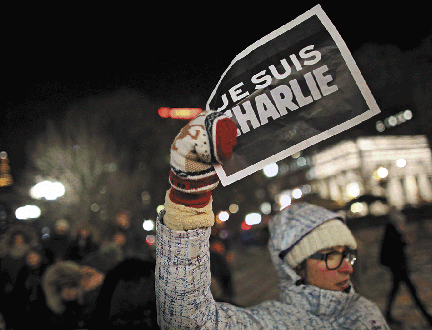
What is really intriguing and somehow disturbing is that Islamophobia is non fading in the 21st century. On the reverse, it is gaining salience. Why? There is no consensus amid intellectuals about the factors that trigger this modernistic Islamophobia. Many intellectuals, both Muslims and non-Muslims, are convinced that Islamophobia is the natural outcome of farthermost violence in Muslim countries, anti-Western terrorist attacks, reprehensible behaviour of certain groups of migrants and the radicalisation of some young native European Muslims.
Other intellectuals claim that the West's disdain of Islam and Muslims has historic roots and is ingrained in Europe's culture of superiority. Others go even further by arguing that in that location is a well-structured and well-financed Islamophobia manufacture that has managed to capture public stance without serious contestation. In this regard, some media, including electronic media, are pinpointed every bit major contributors to the surge of Islamophobia. This argument has been brandished by John Richardson'south book, (Mis)representing Islam: racism and British broadsheet newspapers (2004), and by Jack Shaheen'due south article, "How the media created the Muslim Monster Myth" (Nation, July 2012).
All of these claims are debatable as they oversimplify a circuitous issue. First, there is enough of cruelty in the world, and religiously-motivated violence has erupted in many places, non but in Islamic countries. But one has to acknowledge that Islamist violence has surpassed all other forms of faith-based violence, non necessarily in terms of magnitude, simply in terms of the "theatrilisation" of jihadi violence through social media and the spill-over of terrorist attacks in Europe itself (run across the book published past the Transatlantic University: Organized religion, liberty and foreign policy, NY, 2015).
The argument that Western vilification of Islam is inherent to Western civilization is also a gross exaggeration, as it considers the West as a monolith incapable of empathy and trapped in its closed views of Islam and Muslims. This is historically erroneous since many European intellectuals take come to the defence force of Muslims in the past and in nowadays times (see Edwy Plenel's book: Pour les Musulmans, 2014) and have even highlighted the magnificent contribution of Islam to world civilisation.
While speaking about an Islamophobic industry may suppose that there is a sort of intellectual and political conspiracy confronting Islam and Muslims, this is something I am not fond of. What is sure is that Islamophobia is related to identity politics since information technology allows its adherents to construct their identity in opposition to a negative prototype of Muslims, their culture and faith. The permanent settlement of Muslim migrants, or Muslims of migrant origin, in Europe has brought the "outside within" and has transformed Islam and Muslims into a domestic issue and an internal threat. This change has been exacerbated by the Iranian Fatwa attacks confronting the novelist Salman Rushdie, the riots in the suburbs of France, the terrorist attacks, the cartoon controversy, the assassination of Dutch filmmaker Theo Van Gogh and the latest attacks against Charlie Hebdo's cartoonists.
In a context in which European states are facing an identity crisis, an economic slump and high rates of unemployment, all of these events could only rekindle anti-Islamic sentiment. Europe's Islam has become a scapegoat and a scarecrow. It is not surprising, therefore, that Islam's critics among European intellectuals are becoming best sellers: Oriana Fallaci, in Italy (La rabbia e 50'orgoglio, 2001), Thilo Sarrazin, in Germany (Deutchsland schafft sich ab, 2010), Houellebecq, in France (Soumission, 2015), Christopher Caldwell (Reflections on the revolution in Europe: immigration, Islam and the West, 2009) and Bruce Bawer (While Europe slept: how radical Islam is destroying the West from within, 2006) in England and many others.
At the popular level, anti-Islam sentiment is also dramatically increasing, as revealed past a special study on Islam by Bertelsmann Foundation (2015). Taking Germany as a case study, the 2014 public opinion survey shows the post-obit alarming percentages: 57% of Germans believe that Islam poses a threat; 61% are convinced that Islam is incompatible with the West; xl% say that "because of Islam I feel as a stranger in my country"; and 24% think that Muslims should not be immune to immigrate to Frg. An October 2012 You GOV survey in England also revealed that 49% agreed that there would be a clash of civilisations betwixt Muslims and native white Britons.
These percentages are quite telling. Muslim countries would be ill-advised to ignore them because they are also responsible for the degradation of the image of Islam and Muslims. They cannot just shun their responsibility by sidestepping the upshot and suggesting that Islamophobia is a sort of incurable Western disease or that Islamist terrorists and jihadists, such as the European-native jihadists, Al-Qaeda, ISIS, BOKO HARAM, etc., exercise not represent real Islam and fifty-fifty tarnish the image of Islam, which is a religion of peace. This argument is politically correct, but information technology is self-serving and not credible. Later all, radical Islam is the religious form through which a particular kind of violent political rage expresses itself. It is somehow the "phonation of protest" against the states that failed to alive up to their pledges, confronting the prevailing acquiescence and anomie of Muslim societies and against the ruling elites who harnessed organized religion in the service of political ability.
Thus, instead of blaming the West for its hatred of Muslims, Muslim countries should inquire themselves this difficult question: What went wrong in terms of political participation, economic efficiency and religious educational activity? Why does such a destructive, nihilistic rage come from inside the Muslim community? Why do some rich Arab countries finance and export fundamentalist movements while keeping a tight grip on protest and dissent at home? Unless these questions are correctly addressed, it will exist arduous to uproot radical ideologies, to stifle religious violence in the name of God and, consequently, to dampen the appeal of the Islamophobic discourse.
Counter-radicalization and de-radicalization in European policies
Since the first terrorist attacks in Europe, strategies have been devised, specialised study centres have been set-up and policies have been adopted to counter trigger-happy extremism. The array of policies includes, among other things, the promotion of Muslim integration in European countries by establishing structures for dialogue between representatives of Islam and the governments. In 2003, for example, French republic established the French Council of Muslim faith (Le Conseil Français du Culte Musulman), Muslim ministers were appointed to government chiffonier positions and a new policy for the suburbs (Une nouvelle politique pour les banlieues) was adopted, amongst other deportment.
Anti-Islam sentiment is dramatically increasing, equally revealed past a special written report on Islam
For decades, Germany perceived its migrants every bit temporary guest workers and showed no bustle in facilitating their integration. Naturalisation was restricted until the 1990s. Simply a police passed in 1999 allowed second-generation foreigners to use for citizenship. A 2005 Clearing police force provided funding for mandatory integration courses. In 2006, the German government inaugurated the National Conference on Islam, and in 2007, the Federal Regime adopted the First National Integration Plan, focusing on the promotion of High german values of equality and ceremonious engagement. In July 2010, the German Interior ministry building announced the launch of an leave program to provide help to violent radicals seeking to turn their backs on extremism. Although Germany escaped large-scale terrorist attacks like those of Madrid, information technology has non been totally immune to terrorism. On March ii, 2011, a Muslim Kosovar opened burn on a bus carrying US soldiers and killed two of them.
Holland took a series of measures to promote the integration of its migrants. Already, in 1998, the regime enacted the Newcomers Integration police. Opposite to France, veils accept not been prohibited, only the use of the full veil (burka) past educators and government employees has been banned. A Muslim-oriented broadcasting organisation was ready in 1986. A Muslim and government contact group has been put in place to foster dialogue. In June 2009, the government passed a police force on municipal non-discrimination services. In the same year, in that location were seven Muslim members of the Firm of Representatives, 1 in the Senate, one in the Cabinet, and the Mayor of Rotterdam was likewise a Muslim. Like Germany, Kingdom of the netherlands has not been the theater of large-calibration terrorist acts, just in May 2002, Pim Fortuyn, an anti-Islamic critic, was gunned down, and in 2004, the filmmaker Theo Van Gogh was stabbed to death.
Spain has been a transit country for illegal migration and, after 1990, became a country of concluding destination. Well-nigh Muslims in Spain are Moroccan Arabs and Berbers who gained a living in various booming sectors. Given the vicinity to Morocco, its southern neighbour and economic and fishing partner, Espana generously gave legal condition to the vast majority of illegal Moroccan immigrants. Yet, in March 2004, Kingdom of spain suffered the worst terrorist attack in Europe.
Espana's reaction could have been harsh, simply, on the contrary, the media and government officials showed restraint, avoiding the stigmatisation of all Muslim immigrants. In 2006, a forum for the social integration of migrants (Foro para la integracion social de los inmigrantes) was launched, and over the period of 2007 to 2010, a Strategic Plan for Citizenship and Integration was adopted and was allocated $2 billion Euros for programs in pedagogy, employment, housing, social services, women and youth. The government liaises with the Spanish Islamic Commission (CIE), which officially represents Spain'south Muslims and which coordinates two major Muslim Associations: the Spanish Federation of Islamic Religious Groups (FEERI) and the Union of Islamic Communities. A split in the CIE led to the formation of the Castilian Islamic Council.
Although the policies related to immigration, integration and counter-terrorism are primarily the responsibility of European states, the EU has not remained on the side lines. In May 2004, it published a Handbook on Integration. In September 2005, information technology adopted a Common Agenda for Integration. A Special Fund for the Integration of Third-Country Nationals was launched in 2007, and in 2009, a European Integration forum was established. These are only a few examples of European states' integration policies and the Eu's measures. Whether these policies and measures have been successful or not goes beyond the scope of this article. What is alarming, however, is that all integration policies did non prevent some young Muslim radicals from perpetrating horrific fierce attacks in European countries and thousands from joining the fighting groups such equally ISIS or Al-Qaeda.
Thus, the focus of states' policies is at present shifting towards de-radicalisation and counter-radicalisation. In 2005, the Eu set the tone by adopting a wide counter-terrorism strategy based on four types of action: Prevent, Protect, Pursue and Respond. In the recent years, this counter-terrorism strategy became the pillar of all European states' policies. Grosso modo, all European states take adopted a broad array of measures in response to terrorism and to radicalisation. These include stricter security and surveillance; greater efforts to prevent radicalisation in prison house, in Mosques or through Internet; the promotion of diversity training in schools; the re-exclamation of the secular grapheme of the Land; the preparation of local imams; and the re-insertion of returnees from combat zones. All of these measures move in the right direction. Simply they may prove insufficient if European states persist in ignoring some disturbing facts.
The showtime fact is that the power of ideas has to exist taken into account. Islamist radicalisation is the natural offshoot of the fundamentalist ideology that is infiltrating the social media, invading conservative mosques, and mushrooming through generously-financed Telly channels. As long as European countries tolerate, in their midst, radical imams who preach intolerance and hatred, have that foreign Muslim countries proceed to finance the construction of Mosques, exert structural influence by reinforcing close religious ties with their migrants and look to the other side when conservative Muslim regimes crackdown on their reformists, the fight against radicalisation may show an uphill endeavour.
The 2nd agonizing fact is that information technology is grossly misleading to affirm that only a tiny minority of Muslims back the actions of extremists and jihadists or that groups, such as ISIS, are completely unrepresentative. The reality speaks to the opposite. Radicals enjoy sufficient support non only because they are perceived every bit an Islamist vanguard that refuses Western dictates, simply also because many Muslims nevertheless dream of returning Islam to its past glory. It suffices to read some religious school textbooks in Muslim countries to come across the glorification of the Muslim by and how the West is portrayed as a crusader, infidel or kafer (unbeliever). The European Spousal relationship can use its current policies, such as the European Neighbourhood Policy, the Marriage for the Mediterranean or European union-Gulf dialogue, to tackle these delicate matters.
The third agonizing fact relates to EU policies themselves. In its dealings with Mediterranean, Arab and Muslim countries, European policies take not been coherent. Very often, commercial or strategic interests eclipsed European values. After the democratic Palestinian elections of 2006, the EU did non recognise the legitimacy of the Hamas victory. After the eviction, by Full general Sissi of Egypt, of President Morsi, the kickoff democratically-elected Egyptian president, the Eu reaction was shy, at best. For decades, the Eu turned a blind eye on the occupation and colonisation of Palestine past State of israel, oft described in European media every bit the sole democracy in the region. France and Britain took a leading role in the military operations in Libya without any serious analysis, ex ante, of the possible dramatic consequences of the authorities'south implosion. For too long, the Iraqi Shiite-dominated government has been allowed to impose its sectarian policies without being reprimanded or punished. The Syrian authorities has been immune to destroy its land and slaughter its people, forcing millions to flee the country.
These few examples are only reminders that the fight against radicalisation at habitation and abroad starts past asserting the power of values and ideals in domestic and foreign policies. Communism was not defeated past the ability of arms, simply by the ability of ideals. By the same token, fighting domestic radicalisation by security means only, or bombing ISIS into surrender and submission, is a sure path of failure.
Conclusion
The vast bulk of Muslims in Europe are immigrants or sons of immigrants, and almost half of Muslims in Denmark and Scandinavian countries are political refugees. The bulk of the 235.000 immigrants who have crossed the Mediterranean since January 2015 are refugees and asylum-seekers. The number of Syrians, Iraqis, Afghans and Eritreans among them is ample proof that human being tragedies are today the main drivers of forced migration. The European states are caught by surprise by the magnitude of the phenomenon and somehow concerned by the truth that the vast majority of the newcomers are Muslims who are perceived to be inflating and swelling the European Muslim population of 25 million, a number which already sparks fears in European societies.
The article examined the various stages of migration flows, from temporary labour migration to permanent settlements, and showed the gradual construction of the Muslim problem in Europe and the emergence of far-right anti-Muslim parties. Information technology tackled the effect of radicalisation of some young European Muslims and discussed the de-radicalisation policies adopted by European states. The bulletin which the commodity tried to convey is uncomplicated: Muslims are settling in Europe, and their numbers volition increase in the years to come up. Given this reality, European states should do their utmost to further their integration, and Muslims should contribute by showing their attachment and loyalty to their new home countries.
% in Europe Willingto Accept Muslim Into Their Family
Source: https://www.bbvaopenmind.com/en/articles/muslims-in-europe-the-construction-of-a-problem/
0 Response to "% in Europe Willingto Accept Muslim Into Their Family"
Postar um comentário